

Boat-Based | Popping & Stickbaits | Global Destinations | Hamachi vs Zenaq vs Ripple Fisher vs Smith
There is a very short list of moments in fishing that genuinely stop conversation on a boat. A school of yellowfin tuna erupting on bait at first light, sending a popper twelve feet into the air on the strike, is right at the top of that list. Bluefin do something even more unsettling — they don’t erupt so much as detonate, and the first run from a big one will introduce you to drag settings you didn’t know your reel had. Popping and stickbaiting for tuna from a boat is, without much competition, one of the most visually violent forms of fishing available to anyone with a rod, a topwater lure, and the nerve to hold on.
This is boat-based topwater only — no trolling, no bait, no sounder-watching jig drops. Just casting hardware at feeding fish and making it look like something worth dying for. Here’s where to find the bite, how to work a stickbait versus a popper, and the rods — Hamachi’s lineup measured honestly against Zenaq, Ripple Fisher, and Smith — that actually survive the experience.
Where the Topwater Bite Lights Up
Yellowfin and bluefin don’t sit still for poppers everywhere they swim — you need current, bait, and structure to push them onto the surface where a topwater lure becomes the right tool instead of a novelty one. A handful of destinations consistently deliver exactly that combination.
Panama — The Yellowfin Factory
The Pacific side of Panama, particularly the grounds around the Hannibal Bank and Isla Montuosa, produces some of the most reliable big-yellowfin topwater fishing on the planet. Cow-class fish — 100kg-plus — regularly come up on poppers and stickbaits worked over current lines where bait gets pinned against structure. This isn’t subtle fishing. You’re casting at busting schools, sometimes within sight of porpoise pods the tuna are shadowing, and the strikes happen close enough to the boat that you can watch the fish commit.
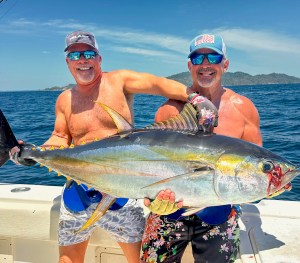
A solid Panama cow yellowfin — exactly the class of fish that makes a heavy stickbait outfit non-negotiable
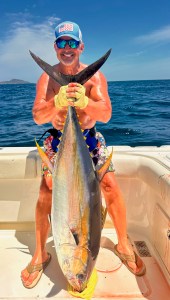
This is the size class that turns a “light spinning session” into a 45-minute fight
Oman & the UAE — The Gulf’s Topwater Sleeper
The Gulf of Oman doesn’t get talked about nearly enough for surface tuna fishing, but the grounds off Muscat and out from the UAE coast hold serious numbers of yellowfin that respond extremely well to poppers and stickbaits worked over current edges and FAD-style structure. The fishery has a genuine competitive scene behind it too — sponsor boats, custom rod builders, and a tournament culture that pushes tackle harder than most recreational fisheries ever will.
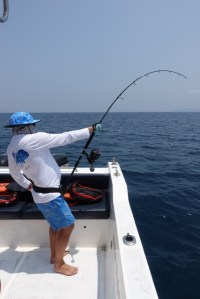
The business end of a hookup off a charter boat out of Oman — Hamachi loaded right through the blank, line cutting hard for open water
Indian Ocean & Maldives — Small Boats, Big Surprises
Not every great topwater session happens off a 30-foot centre console. Some of the most explosive yellowfin fishing in the world happens from traditional dhoni-style outrigger boats working current rips through the atolls — smaller platforms, shorter casts, and fish that hit just as hard regardless of what you’re standing on.
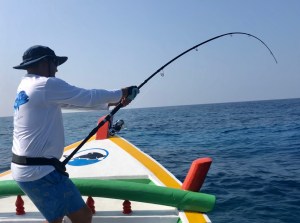
Doesn’t matter what the boat looks like — the Hamachi blank does the same job either way
Mexico & Costa Rica — The Other Yellowfin Factory
Baja’s porpoise-school yellowfin grounds off Cabo San Lucas and Magdalena Bay produce some of the most consistent topwater action in the hemisphere — tuna shadowing dolphin pods, sitting just under the surface, and absolutely available to a well-placed popper or stickbait once you’ve found the right pod. Further south, Costa Rica’s Pacific coast out of Quepos and Golfito holds resident and migratory yellowfin around FADs and current edges that respond just as well to a fast-worked popper as anything in Panama.
San Diego, California — Foamers and the Long-Range Fleet
The resurgent Southern California bluefin bite has turned “foamers” — surface schools annihilating anchovy balls within easy casting range of the long-range fleet — into one of the most accessible topwater bluefin fisheries anywhere. Stickbaits and surface iron worked through a foamer off the Coronado Islands or out on the offshore banks can produce blistering multi-fish stops that most boats only dream about, on fish ranging from schoolies to genuine 100kg-plus models.
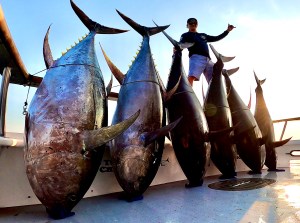
A multi-fish stop on a SoCal long-range trip — this is what a good foamer turns into
Cape Cod & Gloucester, Massachusetts — Giants on the Surface
Few sights in fishing match a school of giant bluefin busting sand eels on top in Cape Cod Bay or off Stellwagen Bank — fish ranging from school-size right up past 600lb, still committing hard to a worked popper or stickbait. This is a run-and-gun fishery that rewards boats that can read birds and bait fast, because the window on a surface school can close in minutes.
The Outer Banks (OBX), North Carolina — The Gulf Stream’s Edge
Warm Gulf Stream water running close to the Outer Banks puts giant bluefin within range of comparatively small boats every winter, and when bait gets pinned against a current break, the fish will come up for a worked stickbait rather than only taking a trolled bait. It’s a cold-water, narrow-window fishery, but the size class on offer makes the wait worthwhile.
Venice, Louisiana & Texas — Yellowfin Among the Rigs
The deepwater oil and gas platforms out of Venice, Louisiana are legendary yellowfin and blackfin structure, and when current pushes bait against a rig the fish will come up to crash a popper worked along the edge rather than sitting deep all day. Texas runs the same playbook further west out of Port Aransas and Freeport, with comparable rig structure producing the same surface opportunities whenever current and water clarity line up.
Reading the Bite — Birds, Bait and Boils
Topwater tuna fishing is a search game before it’s a casting game. Diving birds working a tight area, nervous bait flickering on the surface, and the unmistakable boil of fish working from underneath are the three signs worth running the boat toward. Get within casting range before the school sounds — tuna feeding on the surface can disappear as fast as they arrived, and the difference between a hookup and a story about the one that got away is usually just how fast you got a lure in the water.
Stickbaits — The Walk-the-Dog Retrieve
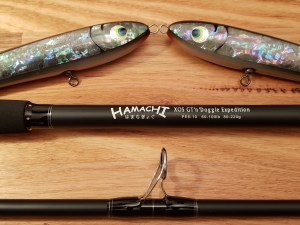
Abalone-finish stickbaits paired with the Hamachi XOS GT’n’Doggie Expedition PE6-10 — built for exactly this job
Poppers — Chug, Pause, Detonate
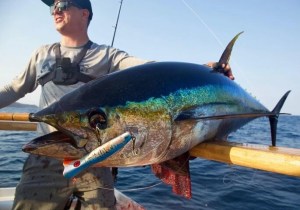
Committed — exactly where you want the lure to end up. Boated off a SoCal long-range boat on the Hamachi XOS GT’n’Doggie Expedition 8’2″ PE8–13.
The Fight — Why Tuna Punish Light Gear
Tuna don’t fight like most other gamefish. There’s no head-shaking, no jumping, no theatre — just a sustained, circular, bury-you-in-the-depths grind that tests a blank’s ability to absorb load for minutes at a time rather than seconds. A rod that casts a stickbait beautifully but goes soft under sustained pressure will cost you fish after fish once the size class gets serious. This is the single biggest reason a dedicated popping/stickbait rod earns its price over a generalist spinning stick.
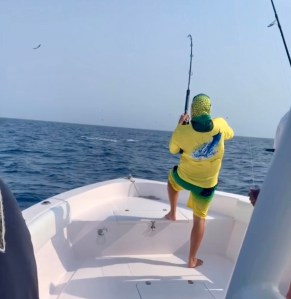
High rod angle, full body weight committed — the standard tuna fighting stance
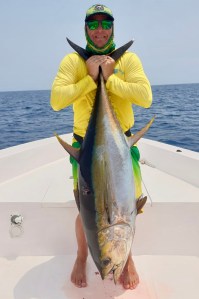
…and a few minutes later, boated
The Tackle: Hamachi’s Popping & Stickbait Lineup
Hamachi builds two distinct XOS GT’n’Doggie Expedition ratings that cover essentially every boat-based topwater tuna scenario you’ll run into, from school-size fish on lighter stickbaits through to genuine cow yellowfin and bluefin on the heaviest poppers in the box.
Hamachi XOS GT’n’Doggie Ultra Long Cast 7’6″ PE2–4 (20–40lb, 30–80g)
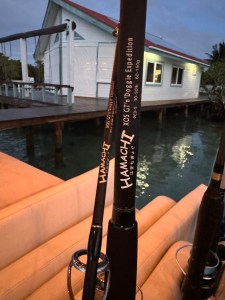
This is the rod for the angler casting all day at schoolie-to-mid-size yellowfin — fish that still hit hard but don’t require you to fight for the better part of an hour. The Ultra Long Cast designation isn’t marketing fluff: this is the lightest, longest-casting blank in the GT’n’Doggie family, built to put a lighter stickbait or popper an extra ten metres past where a heavier rod would land it — exactly what you need when a school is working the surface just out of normal range. Like the rest of the GT’n’Doggie range, it’s a fast-recovery parabolic blank — it loads progressively through the cast for distance and comfort, then snaps back quickly rather than going sluggish, so you’re not waiting on the tip to reset before the next sweep of the retrieve. The PE2–4 rating keeps enough tip sensitivity to work a proper walk-the-dog action without your arms giving out by lunch, while still having the backbone for a 10–25kg yellowfin once it’s hooked.
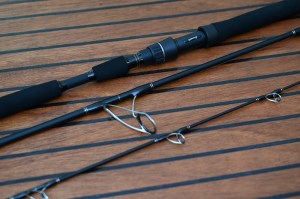
Foregrip and reel seat on the Ultra Long Cast 7’6″ PE2–4 — this is what takes the punishment when a yellowfin leans into the fight
Hamachi XOS GT’n’Doggie Expedition 8’2″ PE8–13 (80–130lb, 100–250g)
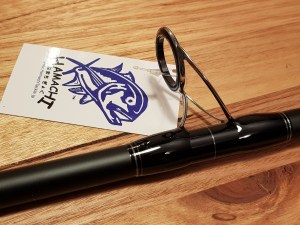
When the size class moves into proper cow yellowfin or bluefin territory, this is the rod you want loaded with a heavy stickbait. The extra length on the 8’2″ format gives you more leverage on a long fight and a longer cast for the bigger 150–250g lures this rating handles. Like the Ultra Long Cast, it’s a fast-recovery parabolic blank — it bends progressively through a long fight to cushion the strike and absorb the grind rather than transmitting every surge straight to your hands, but recovers quickly enough that it keeps transferring real pressure back onto the fish instead of going dead and mushy mid-fight. It’s the same blank family used in Hamachi’s GT-specific rods, which tells you exactly how it’s engineered to behave under sustained heavy load — these fish don’t jump and run, they just lean on you for as long as their lungs hold out, and this rod is built for that fight specifically, not just the cast.
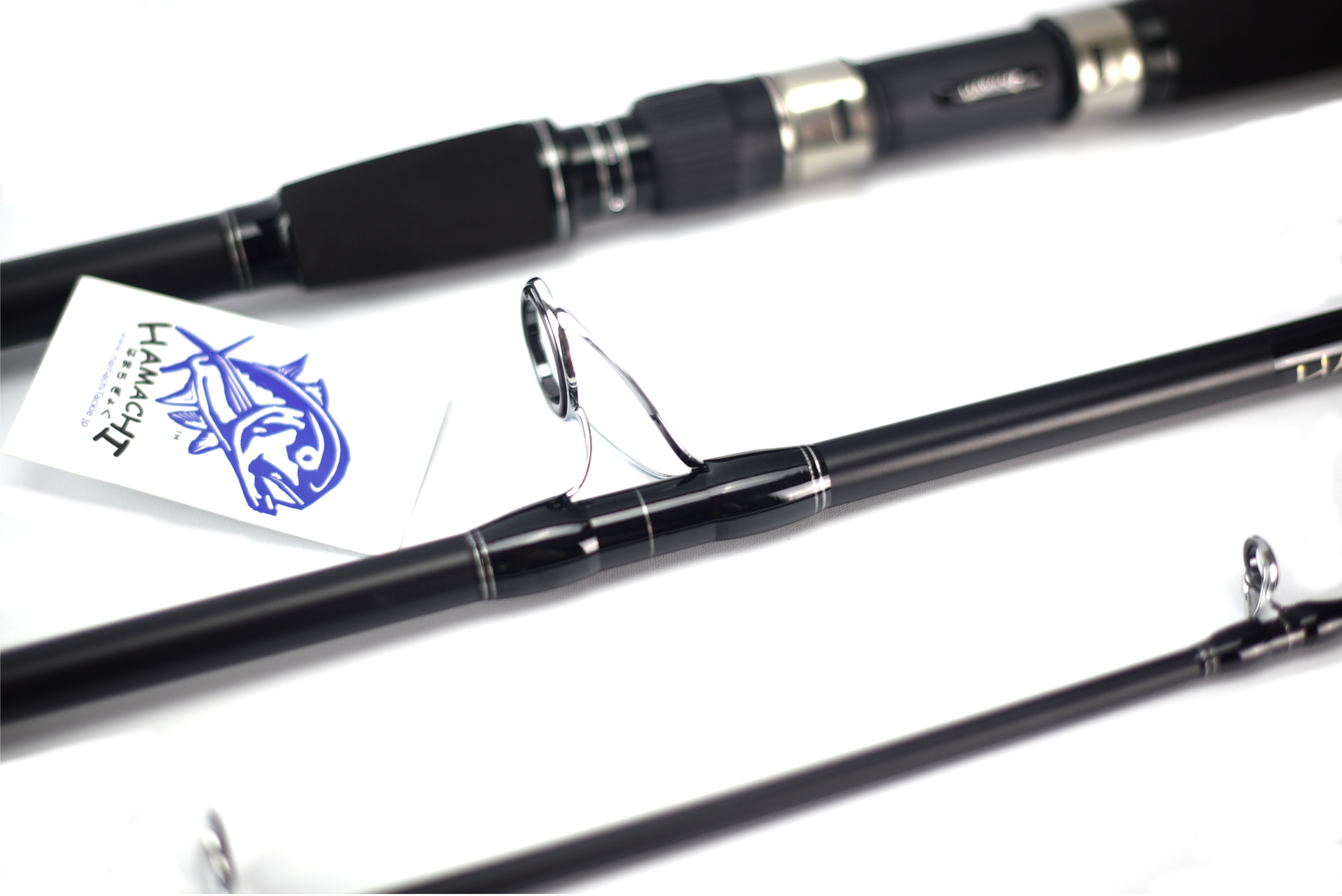
Nano-composite blank and guide train, close up
“Tuna don’t care how well your rod casts a stickbait. They care whether it’s still got something left after fifteen minutes of being leaned on. That’s the whole game.”
More From the Cockpit — Hamachi at Work
Not staged, not stock photos — every fish below came over the rail on a Hamachi rod, across three different oceans.
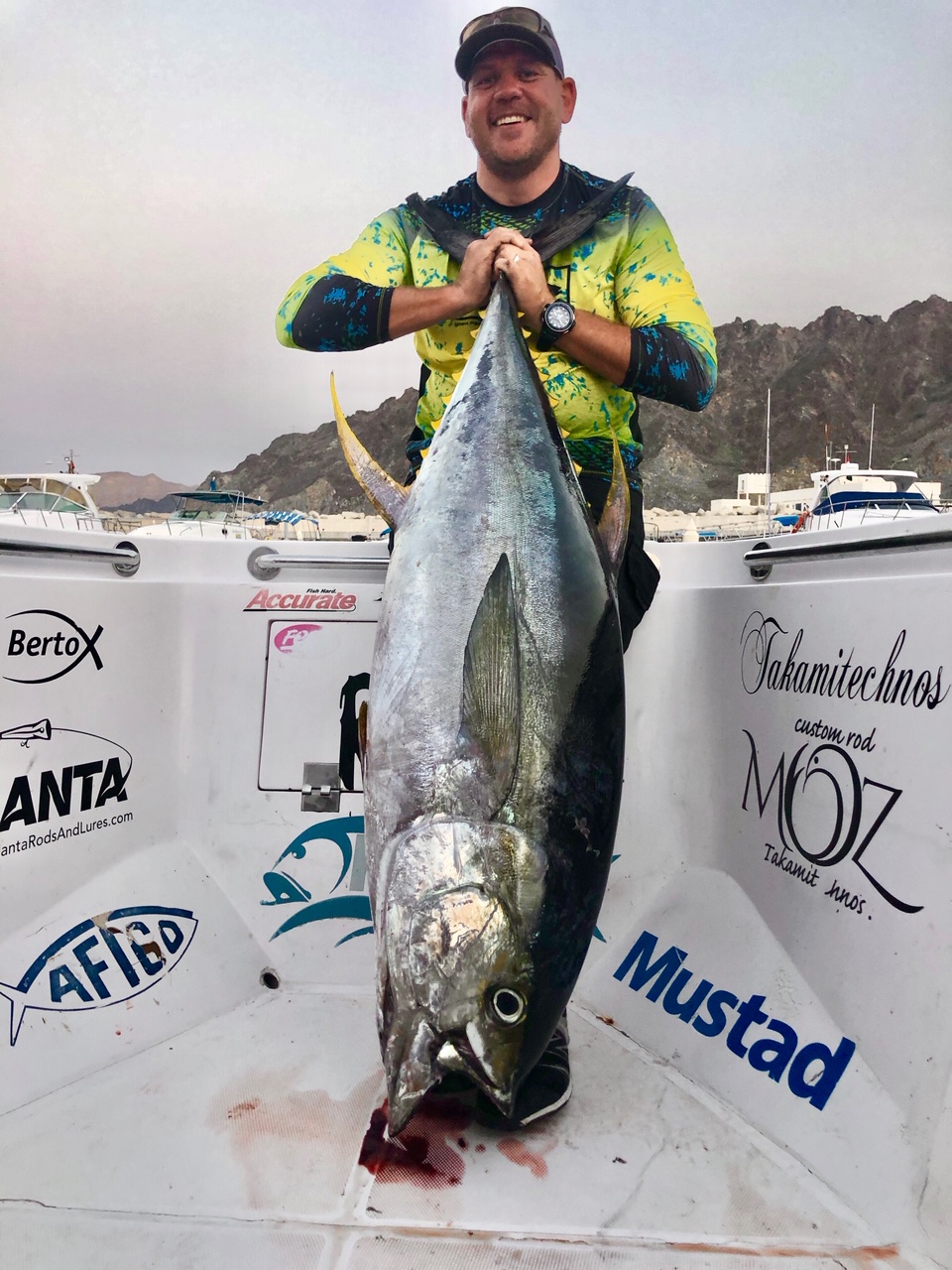
Gulf of Oman cow yellowfin, straight off the charter boat
Another Gulf cockpit, another solid yellowfin on Hamachi gear
Close enough to see exactly why these fish are worth chasing
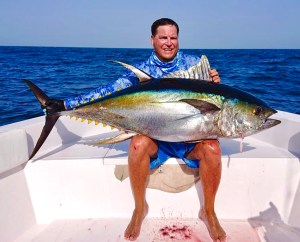
A genuine cockpit-filler, on the same Expedition blank covered above
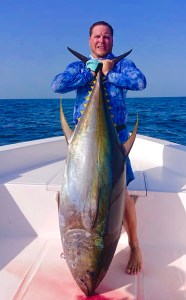
Vertical hold, because some of these fish are taller than the cooler beside them
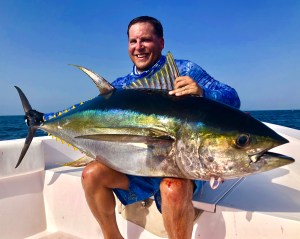
That’s the face every angler makes after this exact fight
The Competition: Zenaq, Ripple Fisher & Smith
Hamachi isn’t fishing in a vacuum here — there are excellent dedicated topwater tuna rods from the major Japanese brands, and a fair comparison means giving credit where it’s earned.
Zenaq Muecca PE5–8 (Discontinued)
The Muecca has a curious backstory worth knowing before you go looking for one secondhand. Hamachi had already been using the “Expedition” name on its XOS GT’n’Doggie travel rods for roughly a decade by the time the Muecca launched as a 3-piece “Expedition” model of its own, in a font treatment that sat strikingly close to Hamachi’s. “Expedition” isn’t a trademarked term, so there’s no legal story here — just an interesting coincidence of timing, naming, and presentation that we’ll let you draw your own conclusions about. What’s not in question is the performance gap: the Muecca never quite had the grunt or casting distance of the real XOS GT’n’Doggie Expedition, and Zenaq has since discontinued it. On a calm day with a lighter pencil stickbait it still casts nicely — that part of the reputation was earned — but it was always a finesse tool only, never built to double as a popper rod or handle the backbone work needed once a big bluefin leans on it. If you come across one secondhand for around $300, it’s not a bad buy at that price — just don’t expect Hamachi XOS GT’n’Doggie Expedition-level grunt, and don’t pay anywhere near the old retail for an out-of-production rod.
Ripple Fisher F-Stick PE6
Ripple Fisher’s F-Stick is a well-regarded popping rod, but it’s worth knowing its limits before you build a session around it: it runs slightly heavier than the GT’n’Doggie 8’2″, and anecdotally its recovery isn’t as fast — it doesn’t snap back from a stroke as quickly as the Hamachi blank does. In practice that makes it a genuinely good rod for smaller-cup poppers up to around 120g, but it becomes hard work once you step up to a big-face blooping popper, where a fast-recovering blank matters far more to keeping the cup working properly through a long retrieve. If your box stays in the smaller-profile range, it’s a fine choice. If the fishery calls for the bigger, loud-cupped poppers, the recovery gap becomes the deciding factor. The same 1- or 2-piece construction that gives it its casting action also means it travels as a full-length rod — typically into oversize airline check-in rather than a suitcase. $800–$1,000 USD.
Smith Offshore Stick OS-66H
Smith’s Offshore Stick range is the value play in this comparison and a genuinely solid one — competent blank construction, a reasonable action for both poppers and stickbaits, and a price point that makes it an easy first serious topwater rod. Think of it as a nice jump up from a mass-produced rod like a Daiwa or Shimano, but a long way short of XOS GT’n’Doggie performance once the fish get big. The compromise is in the fight, not the cast: against a genuine cow yellowfin or bluefin, the blank doesn’t have the same sustained lifting power deeper in the comparison field, and anglers who’ve stepped up from it to the GT’n’Doggie consistently report feeling the difference the first time a big fish really leans on the rod. It’s also a standard 1- or 2-piece build, so factor oversize baggage handling into the trip cost if you’re flying rather than driving to the water. $400–$550 USD.
The Verdict: Matched Tackle for Topwater Tuna
- School-size yellowfin, long-range casting: Hamachi XOS GT’n’Doggie Ultra Long Cast 7’6″ PE2–4. The extra distance to reach a school working just out of normal range, without giving up the backbone to fight what you hook.
- Cow yellowfin & bluefin, heavy stickbait/popper work: Hamachi XOS GT’n’Doggie Expedition 8’2″ PE8–13. Built for the grinding fight, not just the cast.
- Finesse stickbait specialist (secondhand only): Zenaq Muecca PE5–8 — discontinued. Worth grabbing around $300 used for calm-day casting feel; don’t expect Hamachi XOS GT’n’Doggie Expedition-level grunt.
- Smaller-cup poppers: Ripple Fisher F-Stick PE6. Great rod up to around 120g with a small-cup popper; the slower recovery and extra weight make big blooping poppers hard work.
- Best value entry point: Smith Offshore Stick OS-66H. A nice jump up from a mass-produced rod like a Daiwa or Shimano, but a long way short of XOS GT’n’Doggie performance once the fish get big.
Whether you’re working a current line off the Hannibal Bank in Panama, casting into a Gulf of Oman boil with a sponsor-decked boat full of custom rods around you, or fighting a fish off a dhoni in the Indian Ocean, the fundamentals don’t change: get there before the school sounds, match your retrieve to the fish’s mood, and make sure the rod in your hands has something left after the first ten minutes.
Now go find some birds working.
Always Fishing.
Sources & Further Reading
Hamachi XOS GT’n’Doggie Expedition Range — Fishing and Boating Deals Panama Offshore Yellowfin Tuna Fishing — Bluewater Travel Best Fishing Season in Oman — FishFishMe Best Fishing Season in UAE — FishFishMeAbout The Tackle Guru’s authors: We’re a mix of anglers who’ve worked as pro-staff for a number of leading fishing brands, and fishing journalists whose work has appeared in New Zealand Fishing World, BlueWater Magazine, Propellor Magazine and Saltwater Sportsman, on TV shows such as Bill Hohepa, and in numerous newspapers — to name but a few. We test and review equipment across the major rod brands and were not commissioned by Hamachi or The Tackle Guru to write this piece.
Disclosure: The Tackle Guru’s publisher is the AU distributor for Hamachi tackle. More on that here.
 The Tackle Guru
I wish I had known about tour rods befor I bought mt 2 piece rods! They are a pain to Travel with.
James
LikeLike
That they are, and some of the international airline charges for two-piece rods are an eye-watering shock at the check-in counter
LikeLike